
ATLAS DREAM JOB Back to main site

PILOT INTERVIEW PREPARATION

Study in sequence.
Check what you learned.

Each short episode follows Alessio’s Pilot Interview Study Guide. Watch in order, take the knowledge check, and keep your progress on this device.

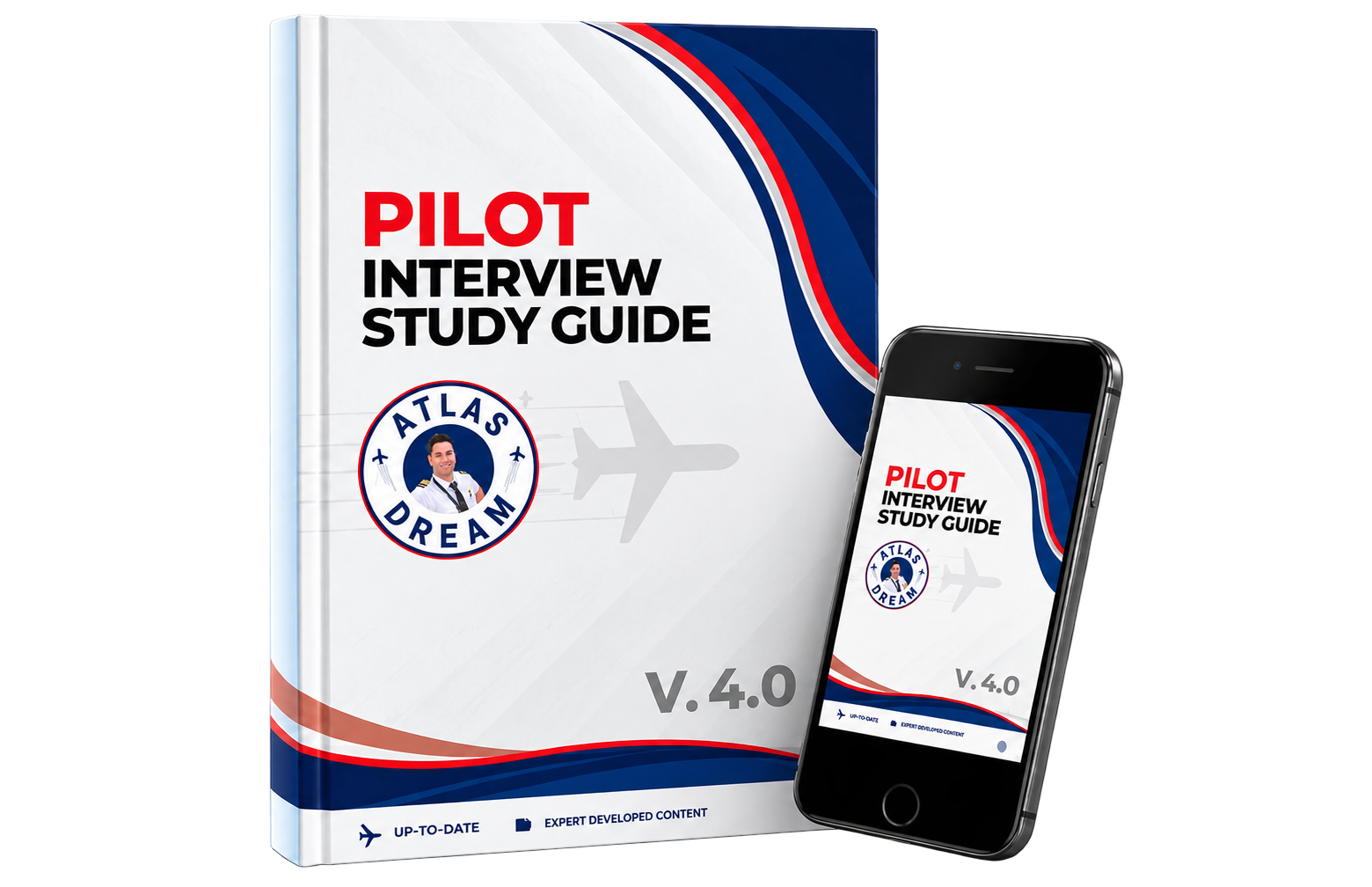
Pilot Interview Study Guide shown as a booklet and on a phone

YOUR PROGRESS

0 of 4 available episodes completed

PRIVATE STUDY-GUIDE ACCESS

Request your personal viewing link

Enter your name and email to receive a private, time-limited link from Alessio. Your request also helps us understand how many pilots this project supports.

Personal access link Private PDF storage Interview follow-up

The message will come from info@atlasdreamjob.com. The guide is for the named recipient’s personal study only.

EPISODE 01

What to Expect in Your Pilot Interview Journey

Ready to study

In this episode

An introduction to the two broad interview areas covered by the study guide: technical reasoning and behavioral discussion. The goal is to understand the structure, not memorize a script.

  • How technical questions evaluate applied reasoning
  • What behavioral questions reveal about motivation and experience
  • Why honesty and lessons learned matter more than a flawless record

KNOWLEDGE CHECK

Ready to test your understanding?

Answer all four questions. A score of 3/4 marks this episode complete.

1. What is the technical portion mainly designed to evaluate?
2. What belongs in the behavioral portion?
3. When discussing a past challenge, what does the guide emphasize?
4. What are the two broad interview areas introduced?

EPISODE 02

Takeoff Speeds: V1, VR, V2, VMCG & VMCA

Ready to study

In this episode

A guide-based review of the takeoff-speed sequence and the decisions connected to each speed.

  • VEF, VMCG, V1 and the accelerate-stop / accelerate-go decision
  • ASDA, TORA and runway-condition considerations
  • VMU, VR, VLOF, V2 and screen height
  • VMCA and why the applicable aircraft data remains controlling

KNOWLEDGE CHECK

Check your takeoff-speed knowledge

Answer all four questions. A score of 3/4 marks this episode complete.

1. Which speed is associated with the takeoff decision?
2. What does ASDA support?
3. Which speed is the rotation speed?
4. Where should you confirm aircraft-specific definitions and values?

EPISODE 03

Takeoff Field Length & Four Climb Segments

Ready to study

In this episode

A source-faithful explanation of takeoff field length and the one-engine-inoperative climb path.

  • The three takeoff-distance cases used to determine field length
  • First and second segments: liftoff, gear retraction and takeoff configuration
  • Third and final segments: acceleration, cleanup and maximum continuous thrust
  • Gross versus net flight path and obstacle-clearance considerations

KNOWLEDGE CHECK

Check your climb-segment knowledge

Answer all four questions. A score of 3/4 marks this episode complete.

1. What begins the first climb segment?
2. Which segment retains takeoff configuration while establishing the required climb?
3. What occurs during the third segment?
4. What is used in the final segment?

EPISODE 04

Icing Conditions, Runway Surfaces & SLOP

Ready to study

In this episode

A source-faithful review of the guide’s icing criteria, runway-surface definitions, and the purpose of Strategic Lateral Offset Procedure.

  • How the guide combines visible moisture with outside-air or total-air temperature when describing icing conditions
  • The guide’s distinctions among dry, wet, and contaminated runways
  • Why SLOP is used to reduce collision and wake-turbulence exposure
  • Why current aircraft, operator, FAA/ICAO, and chart guidance always controls

Current-information note: SLOP requirements and permitted offsets can change. Treat this lesson as interview preparation, not operational guidance.

KNOWLEDGE CHECK

Check your icing, runway, and SLOP knowledge

Answer all four questions. A score of 3/4 marks this episode complete.

1. According to the guide, the temperature threshold used with visible moisture for icing conditions is at or below:
2. Which description matches the guide’s wet-runway definition?
3. What is the main purpose of SLOP?
4. Which source controls during actual operations?